
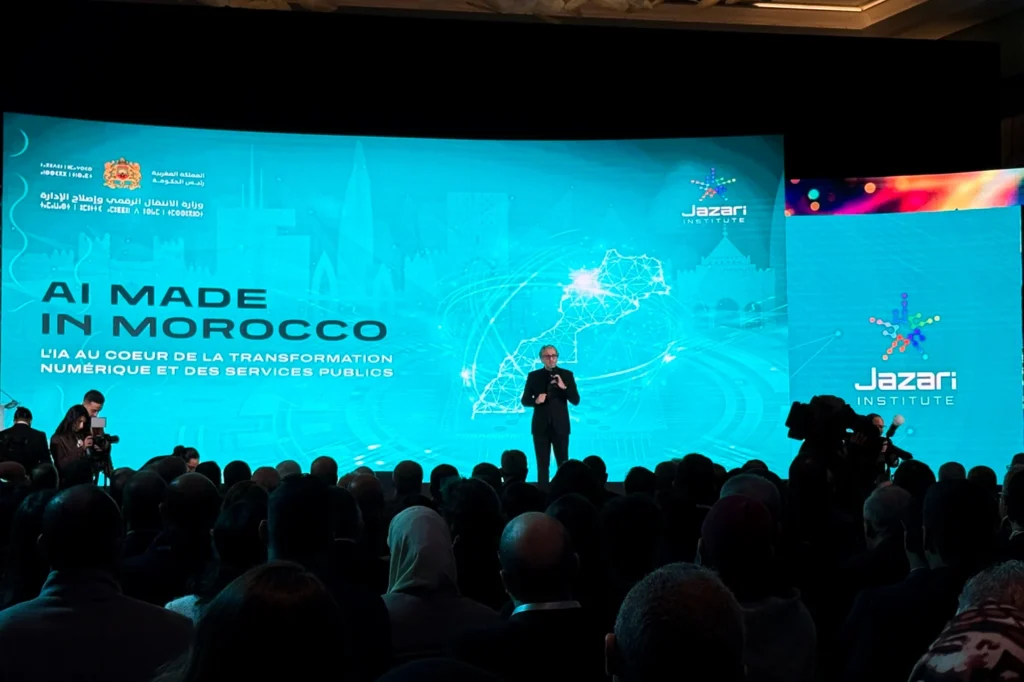

Morocco has officially launched its national artificial intelligence roadmap, “Maroc IA 2030,” as part of a bold national strategy to establish the country as a regional leader in AI innovation and digital sovereignty.
Branded under the vision “AI Made in Morocco,” the roadmap transforms the outcomes of the National Artificial Intelligence Conference—held in July 2025—into a clear, actionable framework for developing homegrown AI capabilities.
The launch event, organized by the Ministry of Digital Transition and Administrative Reform in Rabat, brought together government leaders, institutional representatives, AI experts, academics, and private-sector innovators. Discussions focused on how artificial intelligence can enhance Morocco’s digital transformation and public service efficiency.
JAZARI ROOT: Laying the Foundation for Sovereign AI Development
One of the key announcements was the launch of “JAZARI ROOT,” the first node of a national network of AI Centers of Excellence known as the Jazari Institutes.
These institutes will act as innovation hubs dedicated to training, applied research, and incubation. They aim to connect universities, startups, researchers, and entrepreneurs within a unified national framework—turning Morocco into a dynamic ecosystem for AI education, experimentation, and industrial application.
As part of the roadmap’s rollout, the Ministry signed several strategic cooperation agreements with other government bodies and national institutions. These partnerships aim to strengthen governance, coordinate policies, and ensure the effective implementation of the Maroc IA 2030 plan.
According to the Ministry, the roadmap embodies Morocco’s ambition to bridge global AI advancements with national innovation goals while maintaining digital sovereignty and reducing dependence on foreign technology.
The Jazari Institutes will also play a key role in supporting tech startups, promoting AI adoption among SMBs, and enhancing skills training to prepare Morocco’s workforce for the AI-driven economy. Importantly, each institute will align its specialization with regional economic strengths, ensuring balanced national development.
R&D Cooperation Through Mistral AI Partnership
A major highlight of the event was the announcement of a new AI research and development laboratory, Mistral AI & MTNRA, created through a partnership between Mistral AI—a French leader in generative AI—and the Ministry of Digital Transition and Administrative Reform.
This joint laboratory will serve as a platform for long-term R&D collaboration, hosting technical exchanges, workshops, and co-design projects. Its mission includes the development of AI components, prototype creation, model testing, and the production of technical research outputs to advance Morocco’s domestic AI ecosystem.
Integrating AI Into Morocco’s National Digital Strategy
The Ministry of Digital Transition and Administrative Reform will oversee the integration of the new R&D initiatives into the Digital Morocco 2030 framework. It will coordinate between stakeholders, identify national priority areas, and mobilize public and private innovation resources.
Meanwhile, the Jazari Institute will ensure technological implementation and educational outreach, providing researcher access to cutting-edge AI tools, training, and international collaboration opportunities.
A Strategic Vision for a Smarter, Sovereign Future
The Maroc IA 2030 roadmap reflects Morocco’s determination to combine technological excellence, national sovereignty, and global cooperation. It positions the Kingdom as a reference point for AI governance and innovation in Africa and the Arab world.
Far beyond a ceremonial launch, the Rabat event served as a forward-looking forum of ideas and strategy, with discussions covering AI research, digital infrastructure, investment opportunities, and public sector integration.
Through Maroc IA 2030, Morocco is not just adopting AI—it’s building it, governing it, and shaping it for its own future.